Dear D2Trophy Customers!
We just have relaunched Diablo 2 - Resurrected store, at our main RPGStash store! Enjoy 5% Off Voucher code: D2TROPHY to buy your D2R Gold, Runes, Runeswords and any other items!
Yours, D2Trophy Team
Dear D2Trophy Customers!
We just have relaunched Diablo 2 - Resurrected store, at our main RPGStash store! Enjoy 5% Off Voucher code: D2TROPHY to buy your D2R Gold, Runes, Runeswords and any other items!
Yours, D2Trophy Team

D2R Items for Sale at the Cheapest Prices
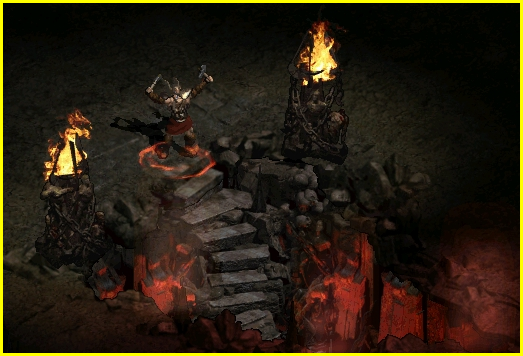
With this small guide I would like to introduce a barbarian variant, which – completely untypical for barbarians – does not engage in close combat in the middle of the monster masses, but is played as a ranged fighter with throwing weapons: the throwing barbarians.
The Thrower is a quite rare barbarian species, which is based on the skill Double Throw. In terms of feel, it is more like a bow amazon, a ranger paladin or various other ranged fighters than the classic Melee Barbarians, which should be reason enough for friends of such characters to give the throwing barbarian a chance.
The Throwable is often said to be badly playable – which is not completely exaggerated, but nevertheless strongly exaggerated. My main concern is to show that with a little good will the thrower is even very playable. Maximum damage and best possible playability are more incompatible with the throwable than with almost any other character – but if you’re looking for maximum damage, you’re completely wrong here anyway. If you accept the peculiarities of the caster, you can have fun with this character for a long time without getting problems with any immunity or special enemies. The Throw Bar can get through anywhere safely and without any significant difficulties.
Have fun reading and playing.
Once again, I have tried to use as few abbreviations or technical terms as possible. Nevertheless, I will list here everything that can be abbreviated in the field of litterables. Most of the terms will be explained in detail later anyway.
Code:
AD – Amplify Damage – Increased Damage (Curse)
AR – Attack Rating – Attack Value (Property)
BC – Battle Cry – Battle Cry (skill)
BCo – Battle Command – Battle Call (Skill)
BO – Battle Orders – Cape Orders (Skill)
CB – Crushing Blow – Devastating Blow (Property)
CNBF – Cannot be frozen – Freezing not possible (property)
CoH – Chains of Honor (Rune-word for armor)
CS – Critical Strike (property) or Chaos Sanctuarium (area in act 4)
CtA – Call to Arms – Call to Arms (rune word for weapons)
Cth – Chance to hit
Dec – Decrepify – Aging (curse)
Def – Defense – Defense (Property)
Dex – Dexterity – Skill (attribute)
DL – Dualleech – Liver and mana aspiration (Feature)
DS – Deadly Strike – Death Strike (trait) or Double Swing – Double Swing (skill)
ED – Enhanced Damage/Defense – Percentage Increased Damage/Defense (property)
Ene – Energy – Energy (attribute)
Faith (runic word for bows / crossbows)
FC/FCR – Faster cast rate
FHR – Faster hit recovery – Faster recovery after hits (property)
Fpa – Frames per animation – Duration of an animation in frames
FR/W – Faster run/walk – Faster run/walk (Feature)
Frame – 1/25 second
Forty – Fortitude – Strength (runic word)
Frenzy – Frenzy (Skill) or Frenzy Bar
Gores – Gorerider – Blood rider (Unique shoes)
Hardcore/HC – pro mode (character can only die once)
HP – Health-/Hitpoints – Life/Hitpoints (Property)
IAS – Increased Attack Speed (property)
IM – Iron Maiden – Iron Maiden (Curse)
ITD – Ignore Target’s Defense – Ignore Target’s Defense (property)
KB – Knockback – Displacement (characteristic)
Leech – Suction (feature)
LH – Lionheart – Lionheart (runic word for armor)
Life – Life (Property)
LL – Life Leech – Life Suction (feature)
LoH – Laying of Hands (Set Gloves, The Student)
max/maxen – fully develop a skill
MaxDam – Maximum Damage – Maximum Damage (Property)
Maek – Mana after each Kill – Mana after direct hit (trait)
MaxSpeed – fastest possible attack speed
Melee – Close Combat
Merc – Mercenary – Mercenary
MF – Magic Find – Chance to find magical items (trait)
MinDam – Minimum Damage – Minimal Damage (Property)
ML – Mana Leech – Mana extraction (feature)
NR – Natural Resistance – Natural resistance (skill)
PI – Physical Immune(es Monster)
Pierce – Piercing (Amazon skill) or Stabbing Attack (trait)
Prism/prismatic – x to all resistors (property)
Rare – a rare item (yellow)
Raven – Ravenfrost – Ravenfrost (Unique Ring)
Razor – Razortail – Blade tail (Unique belt)
Resis(tencies) – Resistors (property)
Slow – Slows down target by x% (property)
Skill – skill or skill bonus (trait)
SLvl – Skilllevel – Level of a skill
Stats – Status points
Str – Strength (attribute)
Trigger – Triggered event (see Basics)
Unique – a unique object (golden)
Vit – Vitality – Vitality (attribute)
WC – War Cry – War Cry (Skill)
WTs – Wartraveler – War traveler (Unique shoes)
WW – Whirlwind – Whirlwind (skill)
Zerk – Berserk – Amok (Skill)
Before we really get started, I would like to explain a few elementary things and terms that are assumed to be known in the following. Even experienced players should at least skim this chapter.
Incidentally, the flight speeds of the projectiles are identical for all weapons.
Stack size and shelf life
Almost all items have a durability that will be affected during combat. Weapons lose durability if you attack with them in close combat, armor items lose durability if you are attacked. Normal melee weapons have a 4% chance of losing one durability point if attacked successfully. Our throwing weapons also have a durability (not shown in the game), which is reduced with a 10% chance in close combat.
The stack size (number), on the other hand, indicates the number of throws you can still make with a throwing weapon. This varies from weapon to weapon and is an extremely important factor for the throwing bar. If the durability of a throwing weapon is used up in close combat, it will be reset to its maximum value and its durability will be reduced by one point. In practice, you have an effective durability of stack size * durability in melee combat, which leads to astronomically high values for some weapons compared to normal melee weapons.
A direct comparison of all basic types of throwing weapons and speed tables can be found in the appendix. Of course, the values for stack size and durability are also listed there.
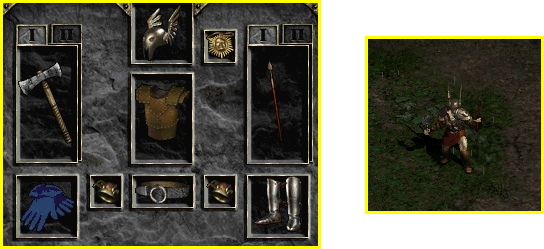
Barbarian and Assassin are able to carry not only a single weapon or a combination of weapon and shield, but also two one-handed weapons simultaneously. A special case are two-handed swords, which the Barbarian can carry both one-handed and two-handed. If such swords are carried one-handed, other (lower) damage values apply than when playing two-handed.
If two weapons are used, the game distinguishes between primary and secondary weapons. In double attacks, the primary weapon is attacked first, followed by the secondary weapon, whereas in single attacks, only the primary weapon is used. The primary weapon is shown on the character in the right hand.
By placing the desired primary weapon in the right inventory slot first and the secondary weapon in the left slot, a strange effect is created in the speed calculation – the so-called speedbug. If you use this effect purposefully, you can increase the attack speed considerably. Since I don’t want to encourage bug usage here and the thrower can’t profit from this bug in any case, I won’t go into this in detail. If you want to do it anyway, please inform yourself.
Attack speed
For the speed calculation of double throw there are no differences between the weapon types. For all throwing weapons only the basic speed (the wsm) of both weapons and the existing IAS is important. However, the IAS of the secondary weapon is not taken into account. For weapons with different wsm, the mean value is calculated. A swinging axe (wsm -10) is thus thrown as fast as a double throw, as is the winged harpoon (also -10) and a throwing knife as fast as a Stygian spear or elixir (all wsm 0).
Mode of action of modifiers for two weapons
Again and again the question is often asked, which characteristics of a weapon are effective on attack with the other weapon and which are not. As a rule of thumb one can say that all modifiers that are directly related to the damage dealt or the weapon are only dealt with attacks of this weapon. This applies, for example:
Only through traits that indirectly affect damage can you increase the damage of the other weapon. Possibilities for this are:
Meet and be met
In Diablo II, an attack made with a weapon must usually pass a hit query. This determines whether the opponent is actually hit or not. The chance of a hit is influenced by the level difference of the opponent (barbarian and monster), the attack value of the attacker and the defense of the defender. The maximum hit chance is 95%, the minimum 5%.
Excluded from this are some special combat skills that always hit (“autohit”), as well as all spells (only affects the war cries of the barbarian).
Frame
A frame is a unit of time. One second corresponds to 25 frames, so one frame has a length of 1/25 or 0.04 seconds. Furthermore, a single frame of an animation is also called a frame, but this is only of marginal interest here.
Frames per Animation (fpa): The duration of an animation, e.g. attack, spell or block. The shorter the duration of the animation, the faster the action is performed. With an attack speed of 5 fpa the barbarian can perform 5 attacks per second (25/5=5), with 4 fpa it is already 6.25 (25/4=6.25).
Reach
In the game there are several units for distances. We are mainly interested in the ranges of bullets, which are usually given in meters (also called yards). The screen is about 23 meters high and 17 meters wide at a resolution of 800×600 pixels. Throwing knives and throwing axes fly with a range of 10 meters a little further than to the left or right edge of the screen at character height (the corners of the screen are not covered), while all types of throwing spears have twice the range with 20 meters.
Synergies
Synergies are skills that reinforce another skill. Only firmly invested points count. Items with skill bonuses do not increase the synergy effect. Synergy skills are listed in the Skill Tree under Bonuses. Usually synergies serve to increase damage. For example, Double Throw gets a damage bonus of 8% per point awarded in Double Swing.
Trigger
Triggers are triggered effects. In a narrower sense, they are properties of some items that are relevant for us:
Let us first look at the barbarian’s skills. All skills that don’t have a score will not get a point, or only the passage point to unlock the next skill. At the end of the chapter there is a clear summary.
In this skill tree are all attack skills of the barbarian, the other two trees are only for support. The skills of this tree can be divided into three groups: Locomotion, Single Attack and Double Attack.
These include jump, jump-attack and whirlwind. While using these skills, you cannot place or pick up items in inventory or belts, so you cannot drink potions or open portals. Another common feature is that all three skills allow you to move over or through other game units (teammates, monsters, etc.), which is not possible with conventional movement. Once started, these skills cannot be stopped until the target location is reached.
Jump / Leap
Available from level: 6
Mana cost: always 2
no synergies
Jump lets the barbarian jump to any point and thus serves only for locomotion, but does no damage. Small obstacles (i.e. no walls or similar) and other impassable places (e.g. the rivers in act 3) can be jumped over. Rule of thumb: Obstacles through which one can see can also be skipped.
The maximum range of the jump is calculated with the following formula:
Range meters = ([26 * [110 * SLvl / (SLvl + 6)] / 100] + 4) * 2 / 3
(SLvl: skill level)
When landing, all monsters within a certain radius are pushed straight away from the barbarian. This radius is:
Radius meters = (4 + SLvl – 1) * 2 / 3
All monsters that can be pushed away are always pushed away; in contrast to pushing away items, the size of the monster does not matter here. The movement speed of Jump corresponds to the unaccelerated racing speed of 6 meters per second. FR/W or other speed modifiers will not work.
One point is usually enough to get out of encirclement, jump over obstacles, or create a natural barrier between you and your opponents on maps like Flame Flow, and then kill them at a safe distance. The range is already sufficient even at quite low levels.
Jump Attack / Leap Attack
Available from level: 18
Mana costs: always 9
Damage %: (SLvl – 1) * 30 + 100
Attack value %: (SLvl – 1) * 15 + 50
Synergy: Jump 10% damage per Lvl
Jump attack is a mixture of jump and a subsequent single attack. If this attack is successful, the monster in question is then pushed back, regardless of monster size. The attack cannot be accelerated or slowed down.
Jump Attack gets quite respectable bonuses to damage and attack value, but these are more than offset by the slow attack speed and fiddly use of the skill. In contrast to normal jumping, the range does not depend on the skill level, so you can jump all over the screen with just one point. A jump attack can only be executed if the opponent is outside the weapon range, otherwise the barbarian strikes with the standard attack.
If the range of Jump is too small for you, you should not extend Jump further, but instead set a point here. But as a real attack we don’t need jump attack, so you don’t need to invest more.
Whirlwind (WW)
Available from level: 30
Mana costs Lvl1: 12,5
Damage %: (SLvl – 1) * 8 – 50
Attack value %: (SLvl – 1) * 5
Mana costs per Lvl: +0,5
no synergies
Whirlwind lets the barbarian move by the shortest route to a targeted point or enemy, spinning fast and flailing like mad. During the movement, the barbarian can strike a blow every 4 frames (0.16 seconds) at optimal attack speed, or even two strikes with two one-handed weapons. For the calculation of the attack speed, only the base speed (the wsm) of the weapon and weapon IAS are considered. However, increases in speed of other equipment or skills, in our case frenzy or fanaticism, do not affect whirlwind.
Whirlwind is executed in walking mode, which on the one hand keeps the defense intact, but on the other hand slows down the speed of movement. In BattleNet this speed is fixed. In singleplayer mode you also benefit from increases in movement speed, no matter if item or skill, but you are also affected by slowdowns of all kinds.
Damage and attack value bonuses are comparatively small, but this is made up for by the enormous attack speed of up to 2 fpa with two one-handed players.
Slash, Paralyse, Concentrate, and Amok only attack one opponent at a time, with each skill providing a few extra effects. All single attacks can be carried out with any melee weapon or with two one-handed weapons. When using two one-handed weapons, however, only the primary weapon is used. In this case the attack speed is different from the standard attack (which uses a special sequence animation with two weapons, which makes the barbarian strike with both weapons alternately).
Slash / Bash
Available from Lvl: 1
Mana costs: always 2
Damage %: (SLvl – 1) * 5 + 50
Attack value %: (SLvl – 1) * 5 + 20
Synergies: Paralyse 5% damage per Lvl, Concentrate 5% attack value per Lvl
If the attack hits, the monster is repelled. As with jumps, there is no difference in size for the repulsion. The same graphic effect used for Destructive Strike is shown on the monster. But this is really just a graphic effect; Slash does not deal a CB. The specified absolute damage bonus does not work for bug reasons, but is only used for Life and Mana Siphon (where it also works against physical Immune).
Paralysis / Stun
Available from level: 12
Mana costs: always 2
No damage bonus
Attack value %: (SLvl – 1) * 5 + 15
Synergies: Slash 8% damage per Lvl, Concentrate 5% attack value per Lvl, War Cry 5% stun duration per Lvl
When an attack is successful, the opponent is stunned, i.e. he is completely incapacitated, and automatically undergoes a hit recovery for the duration of the paralysis with every hit. The duration depends on the skill level and is calculated according to the following formula:
Hour duration seconds = (SLvl – 1) * 0.2 + 1.2
While normal monsters are always paralyzed, the chance for bosses is only 10%. Some types of monsters cannot be Paralyzed or sent to Hit Recovery at all. The damage is only increased by the Synergy Slash.
Concentrate
Available from level: 18
Mana costs: always 2
Damage %: (SLvl – 1) * 5 + 70
Attack value %: (SLvl – 1) * 10 + 60
Synergies: Slash 5% damage per Lvl, Combat Orders 10% damage per Lvl, Amok 1% damage conversion per Lvl
In addition to the good damage, Concentrate provides a temporary increase in defense value during the strike. This bonus is calculated according to the formula
Defence bonus % = (SLvl – 1) * 10 + 100
The defense bonus works exactly as long as you attack, from the first to the last frame of the attack animation.
Concentration cannot be interrupted by other animations; this applies exceptionally not only to the graphic output, but also to the actual internal processes. Many other ‘uninterruptible’ skills just keep the animation running without actually attacking.
Amok / Berserk (Zerk)
Available from level: 30
Mana costs: always 4
Damage %: (SLvl – 1) * 15 + 150
Attack value %: (SLvl – 1) * 15 + 100
Synergies: Howl, scream 10% damage per Lvl
In terms of defense, Amok is the exact opposite of Concentrate: the defense is not increased, but temporarily reduced to 0. The duration of this effect is calculated using the following formula:
Duration seconds = 75 – [(110 * SLvl) / (SLvl + 6)] / 2]
Less than one second is not possible. Special defense bonuses against projectiles or close combat are excluded from the reduction.
All physical damage will be converted to magic damage after the request to double the damage from critical strike or death strike, but before offsetting the enemy physical resistance. As a result, life and mana extraction are no longer possible, but damage from thorn effects is also no longer thrown back.
As a synergy to Frenzy and Concentration, by the way, Amok does not increase the damage of these skills by 1%, but converts 1% of the existing damage into magic damage per point. This is quite useless, because you can also strike with Amok, which converts the entire damage for just one point.
Other barbarians usually set a point here to physically kill Immune with magic damage. As a throwing barbarian, you should instead try to put enough non-physical damage on your equipment to avoid going into melee more often than necessary. If this is not possible, then you also set a point here.
These skills require two weapons to be wielded simultaneously. Two attacks are made in a row, first with the primary weapon, then with the secondary weapon. Damage, hit chance, trigger effects, etc. of both attacks are calculated completely independently. Double Swing and Frenzy can each attack two different targets. First the targeted monster is attacked, the second target is automatically selected. If only one opponent is in range, he gets both attacks.
Double Swing / Double Swing (DS)
Available from level: 6
Mana cost Lvl1: 1 (per hit)
Mana costs per Lvl: -0,125
No damage bonus
Attack value %: (SLvl – 1) * 5 + 15
Synergy: Cut 10% damage per Lvl
In Normal Mode, where no decent throwing weapons are available yet, you usually play the future caster as a melee fighter with this skill. Later on, we are less interested in the active use of double swing than in the synergy bonus of 8% damage for double swing, for which we clearly max this skill. Double Swing itself does not get any damage bonus, but you have to increase the synergy hit.
A few more words about the mana cost of double swing: In the game display, the cost of one point per shot is added, while internally it is calculated separately. Double Swing is only completely free at level 9; however, mana costs are no longer displayed from level 6 on, because the total cost is then less than one point and the game is always rounded off in the display.
Double Throw
Available from level: 12
Mana costs: always 1 (per throw)
No damage bonus
Attack value %: (SLvl – 1) * 10 + 20
Synergy: Double swing 8% damage per Lvl
Our main attack. Double throw lets the barbarian throw two throwing weapons in a row. In contrast to the bow skills of the Amazon, no standard projectiles given by the skill are used here, which means that the characteristics of the weapons carried (e.g. range or airspeed) are preserved as with the normal throw.
Double-throw itself does not offer any damage bonus, but only an increase of the attack value. This is not to be sneezed at, but we usually have more than enough of that, which is why you don’t usually have to set more than one point here, main attack or no.
Important: The damage display of double-throw is bugged. OffweaponED by Throw Control and Double Swing are not added to the other offweaponED sources, but multiplied by them, so the displayed value is about twice as high as it should be.
Just so you know – you shouldn’t trust the damage display anyway, because critical hits, devastating blow and other damage-related traits are not considered there.
Frenzy
Available from level: 24
Mana costs: always 1.5 (per stroke)
Damage %: (SLvl – 1) * 5 + 90
Attack value %: (SLvl – 1) * 7 + 100
Synergies: Double swing, Scorn 8% damage per Lvl, Amok 1% damage conversion per Lvl
Frenzy is at first a normal double attack, compared to double swing and double throw even a rather slow one. What’s special about Frenzy is that the Barbarian’s attack and movement speed is gradually increased with each successful attack. The bonus of each level is always the same; the number of levels corresponds to the skill level. These are EIAS (effective IAS) and EFR/W (effective FR/W), which are not the same as the normal bonuses you get from your equipment. (These are weaker.)
The attack speed of a level is calculated using the formula
EIAS = [50 * [110 * SLvl / (SLvl + 6 )] / 100].
The following applies to the speed of movement:
EFR/W = [180 * [110 * SLvl / (SLvl + 6 )] / 100] + 20
These formulas ensure that the additional benefit of further points decreases the higher the level is already. Frenzy’s bonuses remain active for 6 seconds after the last successful attack with Frenzy, even if you have already reached the highest recharge level.
What makes Frenzy interesting for us is the fact that increasing the attack speed does not only affect Frenzy itself, but also all other attacks. So it’s possible to do a few attacks with Frenzy and then switch to double-throw, which also benefits from the bonus.
If you want to use Frenzy, you don’t have to increase your attack speed completely, because you can already polish up your attack speed with the first few levels. After level 9, no more than 1% EIAS per additional point is added. One point is mandatory in this case, everything else has to be calculated with the TitanSeal attack speed calculator, taking into account the weapons used and individual IAS values of your equipment.
All skills in this tree have a passive effect, i.e. they grant permanent bonuses to the character without having to be used actively. Mana is not consumed. None of these skills have synergies.
The Weapon Controls / Masteries
Available from level: 1 or 6
Weapon Controls increase attack value, physical damage, and critical strike chance when using the appropriate weapon class. Each of these properties is calculated using a separate formula.
Attack value:
Bonus % = (SLvl – 1) * 8 + X
(X = 28 for the level 1 controls, 30 for the level 6 controls, including throwing controls)
Physical damage:
Bonus % = (SLvl – 1) * 5 + 28
Critical strike:
Chance % = [35 * [110 * SLvl / (SLvl + 6)] / 100]
Critical strike is the chance to cause twice the physical damage with one attack. The critical strike of the mastery is not added to Death Strike from the equipment (which has the same effect), but is counted alternately, i.e. first the chance for critical strike is checked and only if this fails, Death Strike is queried. Consequently, the more of one effect you have, the more useless the other one becomes. As a formula it looks like this:
Chance of double damage = CS + (DS / 100 * (100 – CS)
(CS: Chance of critical strike, DS: Chance of death strike)
Critical Strike as an alien skill from the Rune-word Peace will be charged to both the Barbarian’s native CS and DS alternately.
There are some peculiarities with the controls:
Throw Control is our biggest skill-side damage pusher – at level 20 you can dust 182% AR, 123% ED and 29% CS. This skill belongs mapped, of course. If you want to use Frenzy or Amok with spears or axes, you invest one point in the corresponding mastery. But more are not necessary, since we are a throwing bar after all.
Increased endurance / Increased Stamina
Available from level: 12
Increased Stamina increases Stamina by 30% to Level 1, plus 15% for each additional level. Stamina is consumed when the character runs. When stamina is used up, you must stop for a short time to regenerate, or switch to slower walking mode. At the beginning the lack of stamina is noticeable, but later in the game it is almost completely irrelevant. With level 12 this skill is actually already too late 😉
Since we want to skill more speed in most cases anyway, a passage point is added here, nothing else.
Iron Skin
Available from level: 18
Ironskin increases the defense by 30% to level 1 and another 10% from level 2 on, the higher the defense, the lower the chance of being hit by an attack. Defense is not bad in principle, but as a ranged player we don’t put much emphasis on it. If you still want to increase your defense, it makes more sense to skill Shout, which offers the same defense bonus with 10% per level, but additionally boosts combat commands and combat call and also has an effect on mercenaries and the party.
One passage point for Natural Resistance is completely sufficient. Thickened with a few +skills from the equipment, this can even be a nice bonus, which is hardly noticeable in practice. But there are definitely worse passage skills.
More Speed / Increased Speed
Available from level: 24
More speed increases the walking and racing speed of the barbarian. The bonus is calculated according to the formula:
Speed % = [43 * [110 * SLvl / (SLvl + 6)] / 100] + 7
As with Frenzy, this is EFR/W, which is stronger than FR/W from the equipment (whose usefulness becomes less and less the more you already have).
Running faster can actually never hurt; especially with ranged fighters, who occasionally have to make a tactical retreat. With only one invested point you can get a quite respectable increase. With many remaining points and few +skills on the equipment, you can also set two or three points.
Natural Resistance (NR)
Available from level: 30
Natural resistance strengthens our resistance to the elements of cold, fire and lightning, as well as poisonous damage. Resistances to physical damage, magic damage and poison duration are not increased. The additional bonus will also decrease as the skill level increases, the formula applies:
Resistances % = [80 * [110 * SLvl / (SLvl + 6)] / 100].
How many points you invest here must be coordinated with the equipment. One point is obligatory; with a +skill of combat call you already reach 21%. After level 9 (52%) each point only adds two to all resistances, after level 13 (60%) even just one or less. I would bet a maximum of ~5 points. Before you waste ten points or more, you can also simply put a spell with resistances into your inventory and use the skill points more sensibly instead.
The War Cries are a smorgasbord of quite different, but very useful skills. All Shouts have in common that the Barbarian quacks loudly once and uses a spell animation, which can be accelerated by using faster spell rates over equipment.
Technically, six of the Shouts are projectiles that spread out in a ring around the character (similar to the Sorceress’ Nova) and can collide with enemy or friendly game units, releasing different effects. Another three screams are applied to the corpse of a monster. Scorn is a special case that cannot be classified.
Howl, Scorn, and Battlecry count as curses and can therefore override or be overridden by Necromancer curses and other curse effects. The only exception is the Curse Center, which is not overridable. Howl and scorn have an effect on the artificial intelligence (AI).
Generally immune to any curses are the following monsters:
Other monsters are vulnerable to normal curses, but immune to AI effects:
Howl
Available from level: 1
Mana cost: always 4
no synergies
Howl lets all monsters within a small radius flee from the barbarian. As the skill level increases, the flight speed of the scream increases and with it the area of effect. The effect here is the same as with Terror of the Necros or the gruesome protection. In contrast to these effects, monsters flee immediately by howling without ending the current action first. Monsters whose level is higher than the sum of their character level and the level of Howl will not be affected. Escape duration and escape distance increase with skill level:
Escape duration seconds = SLvl + 2
Escape distance meter = ((SLvl – 1) * 5 + 24) * 2 / 3
By the way, all the escape effects let the monsters run away – don’t run away – if they are able to. This allows you to see the run animations of monsters that could theoretically run, but never do in normal play due to AI restrictions. Unlike human players, attacks against running monsters are not automatically guaranteed to hit, but are subject to the usual hit detection. The chance to block is also not affected. The practical difference between running and walking is therefore limited only to movement speed.
This is a very underestimated skill that can be used to quickly take a breath in tricky situations. For us as long distance fighters, the radius may be a bit bigger. From level 5 on, howling is already quite useful; I recommend at least level 10. After level 15, there is not much more to do with the radius. You can invest about 5 points here without hesitation, gladly more.
Scorn / Taunt
Available from level: 6
Mana cost: always 3
no synergies
Scorn must be cast directly on a single monster (or at least near it). The affected monster will run straight to the barbarian and attack him. The opponent loses its second attack and special skills, leaving most monsters to use only the standard attack. For some ranged monsters, the standard attack is a projectile, which is then used at melee range. The monster’s physical damage and attack value is reduced by 5% to level 1, plus 2% the higher the level.
The effect on the behaviour will last as long as the monster does not hit an impassable obstacle. Once at the target location, melee monsters lose their behavior once the barbarian leaves their melee range.
In practice, taunt is extremely useful for forcing dangerous ranged monsters, such as Souls, into melee combat (where they only use their mana-burning melee attack instead of the Bent Lightning), separating individual enemies of strong groups of monsters, or preventing monsters with healing or summoning skills from healing or summoning. Since the tactical benefits are more important than reducing damage and attack value, one point is enough.
Battle Cry (BC)
Available from level: 18
Mana costs: always 5
no synergies
This scream lowers the physical damage and defense of enemies within a small radius of about 3.1 meters around the barbarian. This malus is not cut in half, unlike a percentage reduction in defense via equipment on bosses and in PvP. The Mali of persuasion aura and shadow cloak add to the battle cry. These reductions are calculated on the basis of basic defense without any percentage increases, so more than 100% is quite reasonable in exceptional cases. In combination with absolute defence Mali via Equipment or the skill Inner Sight of Amazon or Huntress the absolute malus works first.
The defence malus of Battle Cry is calculated according to the formula
Defence % = (SLvl – 1) * 2 + 50
The damage is only half as bad:
Damage % = (SLvl – 1) * 1 + 25
The duration is 12 seconds at level 1, with each additional level it increases by 2.4 seconds.
Battle Cry is not suitable for continuous use; the measly range of effect alone ensures this. However, the spell is useful against individual bosses to increase the chance of hitting. Here, too, you don’t need to set more than one point, as the defense is already reduced by 50% at level 1. If you or the party regularly use curses, e.g. increased damage or aging, you can also omit Battle Cry.
War Cry (WC)
Available from level: 30
Mana costs Lvl1: 10
Mana costs per Lvl: +1
Synergies: Howl, scorn, battle cry 6% damage per Lvl
War Cry stuns almost all normal monsters within a 4 meter radius, dealing physical damage (which we don’t care about). Like all stun effects, War Cry has a 10% chance of working against bosses; the damage is always dealt.
The duration of the stun effect is calculated according to the formula
Hour duration seconds = (SLvl – 1) * 0.2 + 1
Whether and how many points you invest here depends on whether you want to use rage in addition to double throwing. Pure casters can completely ignore this skill. If you want to use War Cry, you should not skimp on your points here, because a short duration of time will ultimately do more harm than good. As a guideline, I would aim for at least level 11 for three seconds, or more, depending on your taste and available points.
But I would also clearly advise against war cries with frenzy. The hybrid build plays hard enough without the War Cry. If you don’t charge up on extra-fast, cursing boss groups with Frenzy, you don’t need the skill.
A characteristic part of the barbarian’s play is to renew the scream, battle orders and battle call every now and then, gathering all party members and mercenaries in a pile and then screaming at them.
All three screams have a range of just over half a screen width or just under half a screen height. So you have to stand quite close together. All screams can be active on one game unit at the same time. With several identical effects, not the highest level one works, but the last applied one, in contrast to most paladin auras, which is why you should consult with other barbarians in the party game. Like auras, scream, battle orders and battle call are represented by a small graphic effect on the feet of affected units (scream = orange, battle orders = blue, battle call = white).
Scream / Shout
Available from Lvl: 6
Mana costs: always 6
Synergies: Battle orders, battle call 5 seconds duration per Lvl
Scream increases the defense by 100% already on level 1, with each additional level the bonus increases by 10%. The duration is a meager 20 seconds at level 1 and an additional 10 seconds per additional point, as well as 5 seconds per point in Battle Orders and Battle Calls. Since we definitely max combat commands, even one point adds up to a decent amount of time. This bonus is additive to other percentage defense bonuses that are not on armor items (e.g. iron skin).
The defense plays a rather minor role for us, but the mercenary and party members are of course happy about it. Nice skill of passage.
Battle Orders (BO)
Available from level: 24
Mana costs: always 7
Synergies: shout, combat call 5 seconds duration per Lvl
Battle commands increase Health, Mana and Stamina by 35% at the first level, and an additional 3% from the second level up. The effect lasts 30 seconds at level 1 plus 10 seconds for each additional level. Scream and combat summons increase duration by 5 seconds per point invested. These percentage bonuses to Health, Mana and Stamina only affect the effect:
Battle orders, on the other hand, have no effect:
BO belongs to every barbarian, who doesn’t play exclusively in a party together with another barbarian, absolutely made. However the life doubling is super, about the Manabonus the party members are pleased, perseverance is with level 24 already again all the same. Last but not least fight commands also increase the duration of the other two party cries.
Battle Command (BCo)
Available from level: 30
Mana costs: always 11
Synergies: scream, battle orders 5 seconds duration per Lvl
Battle Call gives all allies a +1 bonus to their skills. The level only increases the duration of the Scream, which is 15 seconds on the first level and increases by 10 seconds for each additional point, and by 5 seconds for both Scream and Battle Orders. By the way, Call to Fight also has a one-time effect on yourself: If you scream twice in a row, the duration is increased by 10 seconds, but the skill bonuses do not add up.
Exactly one point belongs here. The duration is quite good, because we are maxing out combat commands. The Barbarian isn’t a character who is desperately looking for +skills, but especially in the passive tree, many skills benefit a bit from it. And of course the party is happy, too.
Search for elixir, find item, and gruesome protection are cast on the corpse of a slain monster. Unfortunately, this destroys the corpse, making it unusable by the barbarian or party members. Therefore, these skills should always be used with caution in party play. On the other hand, destroying corpses is very useful in some cases, e.g. against the Revived Hordes in Act 5 or all kinds of shamans who resurrect their servants.
Of course, you cannot use these skills on monsters that do not leave corpses. Other monsters leave corpses, but you can’t target them. This affects all nude bosses, some special bosses, and some stationary monsters.
Find Potion
Available from level: 1
Mana cost: always 2
no synergies
When using this skill, there is a chance of obtaining a potion from the corpse of a killed monster. The chance of obtaining a potion increases with the level of the skill:
Chance % = [110 * SLvl / (SLvl + 6)].
If a potion is found, the probability is 60%, 30% and 10% for healing, mana and regeneration potions respectively. The quality of the potion depends on the monster. Additionally, Find Elixir does not work on skeletons and spirits of all kinds, swarms of insects, thorn thrashers, worm eggs, crow’s nests, undead fetishes and knights.
Find Item
Available from level: 12
Mana costs: always 7
no synergies
Find item makes a killed monster drop items again. The only difference to the normal drop is that the NoDrop chance is not given by the TreasureClass and reduced by the number of players, but is calculated based on the skill level. So it doesn’t matter how many players are in the game or in the party. The formula for this is:
NoDrop % = [55 * [110 * SLvl / ( SLvl + 6 )] / 100] + 5
However, the TreasureClass still controls which items can drop. Magic Find and Extragold affect Find Item.
One point is enough to destroy corpses. If you want to take a higher chance of better items with you, you can also bet more here, as you usually have a few skill points left. The throw bar is not suitable for a dedicated MF character, because you can’t even place 300 MF on your equipment without losing a lot of damage. We also can’t afford MF equipment in the second slot for the occasional squeezing of worthwhile opponents.
Grim Ward
Available from level: 24
Mana costs: always 4
no synergies
A fun skill that, contrary to popular belief, is actually very useful in some situations. Gruesome Protection Summons a totem from the corpse of a dead monster. This totem lets all monsters within a skill level-dependent radius flee from the barbarian (not the totem). Like Howl, Necromancer’s Terror, or Monster Escape, this is an AI curse that generally only works on normal monsters, not champions or bosses. The Monster Escape effect is triggered every 0.24 seconds within the area of effect.
The radius within which the monsters flee is calculated using the formula
Radius Meter = (3 + (SLvl -1)) * 2 / 3
The duration of the totem is 40 seconds at all levels. The escape time is quite short with globally 2.4 seconds.
Excluded from further use are the mortal remains of the same monster types as in Search Elixir. As a nice little detail without any practical influence, there are three different totems of different sizes, which are used depending on the size of the killed monster.
Sometimes it happens that monsters that are within the range of a Horrible Protection don’t flee, but just stop and don’t do anything anymore. This problem is especially common in narrow areas, but is very rarely seen outdoors. This seems to be a bug, more information about it in this thread.
Of course, the uses of Ghastly Protection overlap a bit with howling, so you might think that Ghastly Protection is useless. But this is not the case. In practice, it’s very useful to be able to create a monster-free zone for 40 seconds without having to roar constantly. But you can’t rely on the Ghastly Protection alone either, because corpses are not always available in the right place.
If you want to use Ghastly Protection effectively (which I recommend), you should reach at least level 10, otherwise the covered area is too small. But also the ten minutes of fun you can have playing around with this skill would be worth at least one point to me. 🙂
I will briefly summarize the skill distribution again. The compulsory skill needs just 70 skill points, which you reach with level 63. With the remaining points you can individualize your barbarian as you like.
Basic killing
Double swing: MAX
Double cast: 1
Litter control: MAX
More speed: 1
Natural resistance: 1 – 13 (incl. equipment)
Battle orders: MAX
Combat call: 1
Scorn: 1
Optional Skills
Remaining points are first invested in Double Throw (up to about 10000 attack value) and More Speed (up to level 7, only without frenzy, otherwise the barbarian becomes too fast). Whoever still has points left over then builds up Scream further to strengthen mercenaries and party and to increase the duration of battle orders and battle calls. With Frenzy, you could also put more points into War Cry.
Skill order
I do not want to prescribe a detailed skill plan here, but only give a rough direction.
The barbarian starts with the following values:
Thickness: 30
Dexterity: 20
Vitality: 25
Energy: 10
Life: 55
Mana: 10
Stamina (endurance): 92
With every level up he gets 2 lives, 1 mana and 1 staminapoint.
Strength (Str)
Strength and dexterity increase the damage dealt by some types of weapons. This modifier is included in the total damage as offweaponED.
On the other hand, strength is needed to carry the equipment. Usually one of the following end values is to be targeted: 94 (Blood Rider), 95 (Combat Boots), 96 (Swinging Axe), 98 (Hyperion Throwing Spike), 103 (Archon Plate Armor), 106 (Bone Snake), 115 (Wing Helmet), 118 (Stygian Spike, Butcher Protection) or 127 (Balrog Spear). For ethereal items this value is reduced by 10 points.
Unlike close combat barbarians, we only increase strength until the desired equipment can be worn. Strength also increases the damage of our throwing weapons, but so does dexterity and gives an extra bonus to the attack value. If you want to add a few more points to Strength than necessary because you want to wear heavy armour for visual reasons or because you like to experiment with different items, that’s fine too. Attack value is pretty much the last thing a caster lacks, but more is always better than less.
If you don’t know which equipment the Barb will carry later, you can increase the strength to about 80-100 without items, which is sufficient for most things.
Dexterity (Dex)
One point in skill increases the damage of throwing weapons by 0.75% and the base attack value by 5 points. For us it is irrelevant, but still worth mentioning, that dexterity affects the blocking chance if you are wearing a shield. In addition, four points each increase the base defense by one point.
You can never have enough damage and attack value; therefore you simply invest all points here that are not needed in strength or vitality. Depending on your equipment, you can easily reach over 300 skill levels at advanced levels; with very good equipment you can reach 500 and more. Analogous to bow-amazons and other ranged fighters you should equip “Dex-as-dex-can” if possible, i.e. invest as many points as needed for the equipment in Strength and pack the rest in Dexterity.
What you shouldn’t do, however, is to play the hell with Base-Str, put all points into skill (“Dex-only”) and get the required strength from your equipment. This usually requires too many compromises on the items, which will result in less damage than if you had increased strength. Just put on your best clothes and equip Strength if necessary.
Vitality (Vita)
Per point in vitality the barbarian gets 4 health points and 1 endurance point.
On Hell, with good resistances, a life stock of at least 1000-1200 in Softcore is to be aimed for, in Hardcore it may also be about 1500. If you run around with deep red resistances, you will need more life to compensate. Whether you use Frenzy or not doesn’t matter, since you won’t go into close combat in dangerous situations anyway; and otherwise 1200 lives are sufficient. Before hell you don’t have to pay much attention to your life supply, as long as you don’t forget to constantly recast battle orders.
In general, you should try to get as much life as possible from your equipment to be able to invest more points in skill. As a barbarian, however, it is quite easy to get a solid supply of life by building up vitality. Therefore, it is usually better to use your equipment more offensively and increase your vitality than to trim your equipment for life and invest more skill. So it’s better to fill your inventory with damage armor and give it a bit of Vita than to put everything into Dex and then rely on life spells.
As a guideline, I would set a maximum of 50 points in vitality in softcore, but in hardcore I would of course like to set a bit more. Ideally, however, you don’t have to invest anything at all, which can be done without particularly exclusive equipment.
Energy (Ene)
Per point in energy the barbarian gets 1 Mana.
You do not invest a single point in energy. Double casts require only a little mana, and we get this back easily by extracting a little mana from the equipment. With a row of mana potions in your belt, you’ll be well prepared against mana-burning enemies and monsters where manaleech doesn’t work.
In principle, a light-capable throwing bar needs no more than a few decent throwing weapons, which you can already trade for a few perfect gems. A passable rest of equipment can be easily assembled by yourself from the stuff you find while playing through the game, or you can also get it for a small price. So BattleNet players can also start completely without any equipment.
I don’t want to comment on a hundred different items here, but only give some general, practice-oriented hints. I will only take a closer look at the throwing weapons. If you still need a detailed list of all items and stats, you should have a look at the main page: Uniques, sets, rune words, affix lists for rare and magic items
Later I will point out some less obvious options and at the very end of this chapter there are some concrete suggestions for complete setups.
First of all, let’s take a look at which characteristics interest our barbarians at all and which do not. I’m only going to discuss those traits that have some relevance. Things like light radius, mana or MF are quite nice, but they usually don’t have any playful influence and should therefore be neglected when evaluating individual items.
Physical damage
Most important are the weapon damage and absolute increases. OffweaponED we already get in large amounts of status points, the skills and mostly also from the power mercenary. Death Strike is comparatively unimportant, because we already get CS from Litter Mastery.
As a rough guideline, I would consider anything over 100 average damage (weapon + absolute increases) to be light-capable without any problems with the appropriate remaining equipment. With really good equipment of course much more is possible.
Trefferchance (Cth)
The higher the attack value (AR), the better our attacks hit. The level ratio of attacker and victim also plays an important role in calculating the chance of hitting. The exact formula for this is:
Chance to Hit = (100 * AR / (AR + DR)) * (2 * atLvl / (atLvl + dfLvl))
(DR: enemy defence, atLvl Lvl: of the attacker, dfLvl: Lvl of the defender)
The chance of a hit cannot fall below 5% or rise above 95%.
The actual attack value, simply put, is made up of a small character-specific basic value, as well as absolute bonuses of items and skills (5 AR/point each), which are then offset against percentage increases of items and skills.
About 8000 AR is a good and easily achievable value in hell. If you ever reach the five digit range, it’s really slow enough. The added value of AR becomes less and less the more you already have. Since we’re generously building up skill, we already have a thick cushion, which will be strengthened by the throwing control. If necessary, you can also put points into double casts, but this is usually not necessary.
Good additional sources of AR are Raven Frost, Masa’s Scarab and spells with maximum damage and AR. If you have really big AR problems, you can combine amulet and ring from the Heavenly Cloaks set.
The trait -x% Target Defense reduces enemy defense by the appropriate percentage. Against bosses the effect is halved. Ignore Target Defense (ITD) sets the opponent’s defense to 0, so you always have the maximum chance to hit. This does not necessarily have to be 95%; the levels are still taken into account. ITD only works against normal monsters, not against champions or bosses of any kind.
Further possibilities to improve the chance of hitting are against mercenaries (Huntress, City Guard) and in the party game (Persuasion Aura of the Paladin, Inner Vision of the Amazon and Enchanting the Sorceress). More about this in the following chapters. If there is no other way, you still have BC.
Attack speed (IAS)
The attack speed of the throwable is a rather ambivalent matter. On the one hand, a higher attack speed increases the amount of damage dealt quite a bit. Here the ‘more is better’ principle does not apply, but there are different thresholds, which will speed up the attack animation step by step by one frame. Since we are dealing with throwing weapons, a higher attack speed also has the disadvantage that the stack is used up faster and you have to run to the blacksmith for repairs more often. This is not only ineffective, but also incredibly annoying.
Here is a small calculation example: The maximum possible attack speed for double-throw is 3.5 fpa. For example, if you use two throwing weapons with a stack size of 200 pieces each, you can shoot for 56 seconds without interruption before both weapons are completely empty. By the way, 200 pieces are still quite a lot, some elite weapons don’t have 100. In practice, of course, you rarely shoot for a minute at a time and get a few free throws through self-replenishment (which is more effective the slower you attack), but the problem should be obvious. I don’t think I have to explain why you score an own goal when you try to achieve utopian speed values with some lame 75 javelin via speedbug.
I don’t want to recommend here to do without IAS completely or to carry items without IAS – apart from this problem the attack speed is still an important factor for the total damage and should not be neglected at all. But you should keep in mind that there are other ways to increase the damage besides IAS without affecting the playability. So it is definitely not wrong to give up one or two half-frame levels in favor of other damage increases in case of doubt – even if IAS would be more reasonable from a purely mathematical point of view.
In practice, I wouldn’t target any particular speed cap, but simply take as much IAS with me as you get from the items anyway (20 of gloves and possibly amulet + bonuses from the weapon) and at most one more IAS jewel in armor or helmet when another level is in range. Depending on the basic speed of the weapon you can reach between 4.5-5 fpa and 7-8 fpa.
Stabbing Attack (Pierce)
The Sting Attack trait does the same thing as the Amazon’s Pierce skill: it allows a projectile that has hit an enemy to fly through it and damage other enemies. However, this only works if the opponent was actually hit, the hit request must be passed. In total a bullet can pierce up to four times, i.e. hit five opponents – and thus cause five times the total damage. The pierce query is repeated for each monster.
Especially for a throwbarbarbarian, who without Pierce can only hit one monster per attack, this means an enormous increase in damage, but you can’t tell from the damage display in the charscreen. On the other hand, the effective use of Pierce also requires a bit more attention in the way he plays, but that’s no problem.
Pierce can only be found on very few items, for us there are exactly two unique items: the Razortail belt (33% Pierce) and the throwing knife War Shrike (50%).
Razor, if available, is actually obligatory, since it offers an effective damage bonus of ~20% by Pierce alone, even with only two monsters in a row. In the rare ideal case (i.e. with five monsters) it would already be ~50%. And that’s not even counting the additional damage of MaxDam and Dex. No other belt can even come close. You can also get defensive properties elsewhere without having to do without so much damage (which doesn’t even cost extra ammo).
I’ll get to the War Shrike later in the weapons section.
Other offensive properties
Cold Damage slows monsters’ movement and attack speed by 25-50%, the exact value depends on the monster. Cold Immune and some other monsters are not slowed by cold at all. Each cold source has an individual cold duration that determines how long the slowdown lasts. If there are multiple cold sources, all durations are added together. In nightmare mode, the duration is halved, in hell even quartered.
If there is no cold damage anywhere, just put a small spell in your inventory.
Poison damage deals constant damage over a set poison duration, suspending a monster’s life regeneration for the duration of the poisoning. We’re not interested in the low damage, so you really only need to pay attention to the poison duration.
As with cold damage, if you don’t have any poison damage on your remaining gear, you can simply add a small spell to your inventory. If you work a lot with howling or other escape effects, a long poison duration is especially important so that the monsters can regenerate as little life as possible during the escape.
Open Wounds (OW) is in my opinion a very underestimated feature. Once triggered, it deals damage to the enemy continuously over 8 seconds, the amount of damage depending on the attacker’s level. At level 75, it’s about 200 damage per second against normal monsters. Here too, life regeneration is interrupted (even with poisonous immenses). There is no resistance or immunity to OW. Open wounds can only be triggered if the attack deals any damage, no matter how high, to the opponent at the same time. A nice extra source of damage that is also very useful when fighting physical immunity. Of particular importance are open wounds in connection with escape effects.
Open wounds can be found on the Mage, Blood Rider, Dracul’s Grasp, the Rune-word Coercion, and Bloodcraft belts.
Elemental damage, which includes fire, cold, and lightning damage, is not counted towards offweaponED, but it is noticeable in larger amounts. One gladly takes it with him.
If you don’t want to go on a rampage against physical immunity, you should pack as much elemental damage as possible (and best of all, open wounds). The main sources are various weapons. Additionally, the rune-word coercion and the gloves Lava Blast offer some elemental damage. For an effective remedy against Immune, however, it should be a little more, otherwise you’ll be picking on the monsters forever. (Pure patience, as long as you somehow stop the life regeneration)
Devastating Blow (CB) is a special type of damage that takes a quarter of the opponent’s current Health before the actual damage of the attack is dealt. CB damage is reduced by positive physical resistance. Against all types of bosses and in ranged combat, CB damage is halved. This makes CB more useful the more health the opponent has and the faster you attack. The percentage damage is very useful against bosses, but CB is not as noticeable in normal play.
In total, about 20-30% CB is recommended to drastically reduce the life expectancy of bosses, preferably more. It doesn’t really matter if you get it from your own equipment or from a mercenary.
Sources for Destructive Blow include Giant Skull, Guillaume’s Face, Blood Rider, Goblin Toe and Rune-word Coercion. Also very interesting are blood gloves. In principle you can also put one or two alternate items into the chest if you can’t fit CB on your normal equipment anymore.
Leben
Ideally we get our life completely from the equipment. How much life is ultimately needed is a question of personal taste, the game mode and the way of playing. 1000-1200 it should be in hell but in any case. Most valuable for us are direct bonuses on lives, which are additionally doubled by battle orders. This is not the case for vitality and life/character levels, but you’ll still be happy to take such bonuses with you.
First and foremost you get lives from small charms in your inventory (up to 20 per piece). Also good sources are the rune-word Lionheart with a mixture of life and vitality or selfmade magic armor with a maximum of 100. All blood powers also offer a small bonus of 10-20.
Suction (leech)
Life and mana extraction convert a percentage of the physical damage done into life or mana for the barbarian. In Nightmare, the sucked life and mana is halved, in Hell it is even divided into three parts. Additionally, some monsters have a resistance or even immunity against Leech, which further reduces the benefit.
Life Siphoning (LL) is important to keep the red ball constantly full, because even as a ranged fighter you will get hit from time to time. This is especially true for throwing barbarians who use weapons with a short range and as a result are tentatively closer to the opponents. About 5-10% would be desirable, but you don’t need more.
Mana Extraction (ML) is not really needed for double-throw (it is almost made up for later by natural regeneration), other skills are more mana-intensive. Somewhere there should be at least a little bit of mana-suction on it, 2-3% is sufficient in principle.
Resistances (Resis)
All resistors should at least be in the positive range, which is not a big problem for the barbarian, because natural resistance can give 40-60% on all resis if needed. The resistances against the most dangerous types of damage, fire and lightning, are ok from 50% on. In hardcore, it’s better to pack the maximum 75% right away. Cold resistance is negligible as long as you have CNBF. If you have poisonous damage (which is spread over a long period of time) you can also throw in an antidote or a healing potion or go to the healer in town. It’s best to swallow some of these elixirs before you encounter particularly poisonous monsters, which will temporarily increase your poison resistance by 50% and your maximum poison resistance by 10%.
Resistances are actually on almost all armor; Arreat’s Face, Rockstopper, Kira’s Guardian, Tal Rasha’s Horadrim Crest are also good sources. Some resistances can be found e.g. when laying on hands and anger of the high lord. If necessary, the resistances can also be ironed out with pedestals and the inventory.
Run/go faster (FR/W)
The running speed is very important for ranged fighters, both offensively and defensively, e.g. to position themselves tactically cleverly or to avoid attacks. With a point in More Speed, thickened with a few +skills, you’re actually already quite well served; in addition, you usually get a bonus from the boots. Here you simply take what you can get. If you play with speed, you don’t need to worry about FR/W.
Except for Goblin-Toe, practically all useful Uniques have FR/W on them. As a rule, you will be wearing war travelers or blood riders anyway.
Recovery after hits (FHR)
Faster recovery from hits accelerates the Barbarian’s hit recovery animation, which is triggered when you lose a certain percentage of your maximum health supply. There are different gradations of probability depending on the type of attack and the amount of life lost, but in practice this does not matter. Without any bonuses, the barbarian already has a recovery of comparatively fast 9 fpa, which can be accelerated even further with 7, 15 or 27% FHR. A complete table can be found in the annex.
Lamb (stun) is dealt by some monsters, e.g. Urdars, and causes the character to be forced into hit recovery for the entire duration of the stun from any further successful attack.
As a ranged player, we don’t really have to pay attention to FHR because we are rarely hit. If you play with Frenzy and/or Hardcore, you should at least crack the second or third level. All others can safely ignore FHR.
Defence (Def)
A high level of defense ensures that you are less likely to be hit by enemy attacks if your character is standing or walking. All spells and some combat skills do not perform a hit check and therefore always hit – completely independent of the defense value. If the character is running, no hit check is performed for combat skills.
Like hit recovery, defense is not really important, because as ranged fighters, we ideally don’t have the embarrassment of being hit by an enemy. However, since hits are unavoidable, you’ll be happy to take defensive bonuses with you – as long as you don’t suffer any disadvantage elsewhere. If the other items or blanks are the same, you can choose the one with the higher defense.
With “good” blanks for rune words with 5-15% increased defense, the fun ends for me for good. These things cause immense repair costs without having even the slightest noticeable benefit in the game.
Damage and magic damage reduction (DR/MDR)
The traits “Damage” or “Magic Damage Reduced by x” reduce the damage received by the character by an absolute amount before being deducted by the resistances. Damage reduction affects physical damage, magic damage reduction affects cold, lightning, fire, and magic damage. When combining both properties, an interesting effect occurs: If the sum of DR and MDR is at least as high as the nominal damage of any enemy damage source, no damage is dealt to the character, regardless of the actual damage type. When targeting DR and MDR, you can completely disarm normal monsters. However, this defensive concept requires a lot of damage, which is only acceptable in hardcore mode.
Suitable items would be iron fur, Curse of the Gladiator, ear chain, dwarven star, vampire look, and anything else you can socket sol runes for DR. Only damage reduction is useful as a single trait; elemental damage is reduced to a tolerable level by the resistances alone.
Physical damage reduction is also available in percentage form. This is nothing more than a non-displayed resistance to physical damage, which, unlike the other resistances, always has an initial value of 0 and is capped at 50%, regardless of the difficulty level. Unlike absolute damage reduction, which provides good protection against Amplified damage/ageing, percentage reduction leaves you very vulnerable to physical damage in such situations. Unnecessary and also difficult to obtain.
Skill bonuses (+skills)
Skill bonuses are traditionally not important to fighters, unlike spellcasting characters, because they play only a minor role in terms of damage. In the case of the throwable, however, a lot of skills benefit at least a little bit from them, which is why I recommend at least a small cushion. Especially if you really want to use all the optional skills suggested in chapter 2, it could be a bit tight without +skills. About 3-5 +skills would be nice.
If you have a Domination or War Cry giant spell with a nice extra trait (Life, FR/W or MaxDam) lying around somewhere, you can pack it in.
Freezing not possible (CNBF)
Under the influence of cold damage, a game character is slowed by 50% in its attack and movement speed for the duration of the cold. CNBF prevents this; you just take the cold damage without being frozen. However, CNBF does not work against the slowdown caused by a Holy Frost Aura.
CNBF is not absolutely necessary, since we avoid enemy contact anyway if possible. In most cases CNBF is obtained from raven frost, which is recommended for its residual properties alone. If you do not have it, you can alternatively wear Duriel’s shell or Kira’s guardian.
Repulsion (KB)
Repulsion pushes a hit opponent in a straight line about 2 meters away from the character and forces him into a hit recovery. The chance of being pushed away is controlled by an internal monster size (which has nothing to do with the graphics output). Small monsters are repelled with every successful hit, medium monsters have a 50% chance and large monsters have a 25% chance. Some monsters are also completely immune to rejection, including all nude bosses and various stationary monsters.
The trait only works once, so it is not possible to increase the probability, range or anything else over multiple items with KB.
Repulsion is very useful to keep (or bring) monsters at a distance, but you can also use Howl for that, so KB is not really important in my eyes. A small disadvantage still exists when using knives and axes, where the enemies are pushed out of range from time to time, but in practice this is not that bad.
KB you get from giant skulls or crafted punching gloves. In the budget range you get Heulhauer and Cleglaws Pinchers.
Monster Flight (Flee)
Monster Flight, like Howl, causes a hit monster to flee directly from the barbarian. Of course, Monster Escape does not work against all bosses and some normal monsters that are immune to AI Hexes.
Monster Escape is a matter of taste; some players find it very useful, others extremely annoying. Just try it out for yourself. Monster Escape isn’t really important to us anyway, because with Howl and Scary Protection we already have two skills that have the same effect. Possible sources for Monster Escape are Rattling Cage (~41%), Howl Tusks (25%), Face of Horror (50%) and Power of Strike Amulets (~4-12%).
Other defensive properties
The following stats are welcome to take with you if they are on an already good item, but they are not really important or crucial to the game.
Absorption converts a portion of the damage taken back into health. Also absorb exists in both absolute and percentage form, with percentage absorption being limited to 40%. For hardcore players, it makes sense to have an item with lightning absorption in your chest when traveling in areas with souls. You can choose between Blackhorn’s Face, Thunder God Thrive or Wisp Projector.
reduced poison strength (PDR) reduces the duration of poisoning (not the damage, that’s what poison resistance is for). This is a separate resistance, which is 0% in Normal mode, -40% in Nightmare and -100% in Hell.
In order to be able to play reasonably fluently, you need four throwing weapons, two for each weapon slot. If you like, you can additionally carry one or two pairs in your inventory or horadrim dice, which would be much too complicated for me personally. In battle you first empty one slot and then switch to the other. If this one is empty as well, you go via the city portal to the next blacksmith and get them filled up again. If the weapons in the first empty slot are self-refilling, you can switch to the first slot again after the second slot is empty; that’s enough for some monster groups. Ideally, if you have self-replenishment, you should first throw a few weapons from that slot (~30 from each weapon) and then continue playing with the other weapon set while the weapons in the first slot replenish. Unlike in a Java zone, self-replenishment will never be enough to keep the number of weapons constantly high. It should also be noted that repairing a self-repairing weapon always costs just one gold piece, while without this feature it can quickly become quite expensive, especially for rare weapons.
Increased stack size is also very useful. Apart from the fact that these two stats – self replenishment and increased stack size – are much more pleasant and stress-free to play with, they indirectly increase the damage, of course, because if you have to run into town less often, you kill more monsters in the same amount of time.
When combining two weapons in a slot, make sure that both have approximately the same stack size, otherwise the ‘overhanging’ number, i.e. the difference between the two stack sizes, is practically useless. For example, if you have two spears with only 80 stack sizes and two knives with 200 stack sizes, you should put the knives in one slot and the spears in the other, otherwise the spears will be empty, while the knives will have 120 left. Since only double throwing counts only IAS from the primary weapon, you should of course put the weapon with the higher IAS value in the left weapon slot.
Both weapon slots are equipped in such a way that you can play reasonably with them independently. We cannot afford the luxury of a separate ancast or trigger slot due to acute lack of space. It is of course advisable to switch to the more appropriate slot in special situations, if you are carrying different weapons. On souls, succubi and other caustic ranged fighters you logically don’t bother with knives if there are two virgin spears with double range in the second slot. And if you fight with a boss for two minutes, you can switch to the AD weapon in the second slot, if available. But you don’t occupy a valuable slot exclusively for such extreme situations; in normal play, both slots should work effectively.
If you want to use Frenzy because of the speed increase or amok against physical immune, you can do so with the normal throwing weapons and not with an additional weapon combo in the second slot. The use of Frenzy may seem counterproductive at first sight in view of the already mentioned IAS problem, but in my experience this is not the case at all. On the one hand, you don’t charge yourself with Frenzy permanently, but only occasionally (e.g. in densely populated areas) and otherwise play like a normal throwing bar. On the other hand you inevitably spend a good part of the game time in close combat with Frenzy, which in return is extremely durable and roughly makes up for the increased stacking loss in long-range combat. If the number of weapons is approaching 0 after a longer stay in the wilderness, you can also delay your visit to the city a bit by killing a few weak monsters with Frenzy.
I would strongly advise against the use of ethereal throwing weapons, which, as is well known, cannot be repaired by the blacksmith or via dice recipe, because of the stacking problem. You might lose a little theoretical damage, but that’s the only way to do it. As we’ll see later, the ‘optimal’ weapons offer comparatively little raw damage anyway, so a relatively large part of the damage usually comes from absolute bonuses of charms anyway. If you still want to play with ethereal weapons, you’ll have to put a whole arsenal of self-replenishing weapons in your chest to have four full weapons at hand. You’ll need at least eight of them when you’re really active…
As a side-effect of this system, the BO-weapons with +3 to war cries in the second slot, which are popular with other barbarian variants, are of course no replacement for us. That’s not too bad with regard to the life supply, only the comparatively short duration of the shouts is a bit disturbing. Such weapons could theoretically be placed in the chest and used as needed; however, in my opinion, the benefit in relation to the effort is far too small. By the way, the same applies to demon limb, CtA and other kid stuff, with which we can’t do much.
Well, let’s have a look at the weapons in question. Since there are no rune words for throwing weapons, the choice is limited to a handful of Uniques and two or three alternatives.
For the speed specifications I assume that two weapons of the same basic speed are carried. Bonuses of the item are already included.
I only mention the most important caps in my opinion, Frenzy is not considered here.
War Shrike
War Shrike is probably the best thing you can put in a barbarian’s hands. 50% Pierce, 50% DS and a good attack speed get a lot out of this part despite the relatively low weapon damage. Self replenishment and the stack size also provide for optimal gaming comfort, only the Nova on impact is annoying. If enough raw damage from the inventory and sockets comes together, War Shrike is hard to beat in terms of damage. War Traveler is also a very good addition.
Speed: 5 fpa – 12 IAS, 4.5 fpa – 40 IAS, 4 fpa – 90 IAS
Stack size: 200
Self-refilling: 3.33 seconds/piece = 18 pieces/minute
Deathbite
Here we have a nice passage weapon, which is already wearable from level 44, i.e. beginning nightmare. Thanks to self replenishment and a decent stack size, you can now play properly as a throwing bar for the first time. The damage is very good for your level, plus life and mana extraction. You can also use the knives on Hell with some limitations.
Speed: 8.5 fpa – 2 IAS, 8 fpa – 6 IAS, 7.5 fpa – 13 IAS, 7 fpa – 19 IAS, 6.5 fpa – 29 IAS, 6 fpa – 40 IAS, 5.5 fpa – 60 IAS
Stack size: 160
self-refilling: 4 seconds/piece = 15 pieces/minute
Mashers / Lacerator
A very interesting axe. The Maucher offers decent damage and a 33% chance to deal level 3 Enhanced Damage on impact. However, many players are bothered by the 50% chance of monster escape, which sometimes overruns AD. On the other hand, this is of course a great defensive concept and very helpful in many situations. Open wounds do quite a bit of damage and are especially useful for physically immune players. Monsters that run away and bleed to death are not a bad combination… 🙂
The speed is quite good, typical for an axe.
Speed: 5.5 fpa – 10 IAS, 5 fpa – 33 IAS, 4.5 fpa – 69 IAS
Stack size: 180
self-refilling: 4 seconds/piece = 15 pieces/minute
Gimmershred
Micaceous shards are already quite a bit slower than the mackerel. The only really interesting thing here is the massive elemental damage, with the help of which you can physically knock or beat Immune to death in no time at all. Unfortunately there is no self-replenishment on it, so I would only use this throwing axe as main weapon if there is nothing else. Otherwise you can put a pair in the chest (and in certain areas in the second slot) against Physical Immune.
Speed: 6.5 fpa – 16 IAS, 6 fpa – 30 IAS, 5.5 fpa – 56 IAS
Stack size: 240
Self-refilling: missing
Der Scalper
Another good passageway weapon for nightmare mode. Level 57 is already quite late, but it still takes a while until the really strong weapons are available. In terms of damage and speed, scalpers and death bites are about equal, so a switch is usually not really worth it. Can also be used on Hell if necessary.
Speed: 7 fpa – 14 IAS, 6.5 fpa – 26 IAS, 6 fpa – 40 IAS, 5.5 fpa – 66 IAS
Stack size: 130
Self-refilling: 3.33 seconds/piece = 18 pieces/minute
Demon & #8217; s Arch
The most sensible spear in my eyes: a balance of speed and damage, lots of elemental damage against the immune system, life sucking and self replenishment. The stack size of 80 is a joke though, you’ll have to run into the city more often here. Apart from that, Demon Bow is at least very good as a second slot or exchange weapon against physical Immune.
Speed: 6.5 fpa – 16 IAS, 6 fpa – 30 IAS, 5.5 fpa – 56 IAS
Stack size: 80
Self-refilling: 3.33 seconds/piece = 18 pieces/minute
Gargoyle & #8217; s Bite
Gargoyle bite is weaker than Demon Bow, doesn’t offer much against Immune – and is just too fast for its small stack size. If it has to be a spear, then demon bow is better. The weapon is usable, of course, but there are simply better ones.
Speed: 6.5 fpa – 15 IAS, 6 fpa – 24 IAS, 5.5 fpa – 40 IAS, 5 fpa – 63 IAS
Stack size: 80
Self-refilling: 3.33 seconds/piece = 18 pieces/minute
Wraith Flight
These toothpicks are not bad either, but unfortunately always ethereal. The damage is brutally high, although Pierce is missing, of course. The combination of pleasantly low attack speed and high refill speed is quite useful.
Speed: 9 fpa – 20 IAS, 8.5 fpa – 26 IAS, 8 fpa – 32 IAS, 7.5 fpa – 42 IAS, 7 fpa – 52 IAS, 6.5 fpa – 68 IAS
Stack size: 75
Self-refilling: 2.5 seconds/piece = 24 pieces/minute
Rares
With a bit of luck, rare throwing weapons can be better than the Uniques, but this almost never happens in practice. Rares can have three so-called pre- and suffixes each. The possible characteristics are almost identical for knives, axes and spears, knives can still get skill bonuses for the Necromnancer, spears skill bonuses for the Amazon. Desirable affixes are:
Prefixes
Suffixes
Complete lists can be found here. All rare weapons with a stack size of at least three digits, self replenishment and at least 200% ED are quite usable, but for a serious alternative to the Uniques it should be a bit more. Such weapons are not exactly a dime a dozen – and what makes it even more difficult is that ideally you don’t want just one, but four of them. Ethereal weapons are even less useful here because of the much slower refill speed compared to the Uniques.
A good way to get rares is the enchantment at Charsi. Ghostgleve, Winged Harpoon and Swinging Axe can be enchanted at level 8 and get all kinds of properties. The levels for other weapons are listed here.
Crafts
Forced items are made in the Horadrim Cube from a magic item, a rune, a perfect gem and any jewel. You can read important background information on crafted items here. Crafted items always have three to four fixed properties and up to three prefixes or suffixes each, which can also appear on rares. However, no more than four affixes are possible per item. There are two possible recipes for the weapons:
That takes care of the weapons issue. If no utopian rares or blood-crafts are available, the damage-conscious barbarian usually resorts to war stranglers or butchers. Among the other weapons there are at least a few good passage and anti-PI weapons, as well as useful alternatives for those who don’t have other weapons at hand.
For the remaining slots I would like to give a few examples without claiming to be complete, without going into the stats in detail. Just follow the links if necessary. I’ll get to magical and enforced items in a moment.
Helmets: Arreats face, giant skull, Guillaumes face, Andariels face, Tal Rasha’s Horadim crest, rare hoop with Leech/Stats/Sockets/+Skills, magic socket helmet, bloodcraft
Armor: Strength, Chains of Honor, Lionheart, Coercion, Duriel’s Bowl, Viper Mage Skin, Smoke, Peace, Rattling Cage, Magic Base Armor
Gloves: Lay on hands, poison grip, lava thrust, blood fist, rare/impact or blood force with IAS/Resis/Leech
Belt: Razor, if you don’t have it, take something with Stats/Resis/Leech
Shoes: war traveler, blood rider, goblin toe, alternatively anything with FR/W
Amulets: Wrath of the High Prince, Atmas Scarab, Cat’s Eye, Rare/power or bloodcraft with +Skills/Leech/Stats/Resis
Rings: Rares/Blutcrafts with Leech/Resis/Stats, a raven frost is never wrong
Inventar: if necessary, polish up life and resistances, after that you can fill the rest with MaxDam
Sockelungen: like Inventory, although ED may be preferable here instead of MaxDam
Actually only armour and helmets with sockets for damage jewels are interesting here. The less raw damage a weapon offers, the more worthwhile minimum or maximum damage is in comparison to damage increased by a percentage. For example, a perfect War Shrike has a weapon damage of 94-122, and wearing four cheap, naked +15 MaxDam jewels in armour increases damage by ~30%. And such jewels are thrown after you; there is much more to it. Weapons with high base damage are of course better off with a percentage damage increase. IAS armour or hats, as known from bow amazons, are not recommended because of the stacking problem.
Armor offers up to four sockets and either up to 100 health, 0.75% health/character level (does not count against BO), 24% FHR, 20 strength or 15 skill. Such items can be bought from the dealer at the corner, the fastest way to get anya from Nightmare is if the red portal is still standing. If you don’t have a good magical socket armor, you can alternatively go for Griswold’s Heart or Black Hades, which have only three sockets, but bring some additional damage and good defense.
With the helmets one must differentiate between the normal helmets, tires and the class specific barbarian helmets. On all three, up to three sockets are possible, the additional features are different.
Powerful recipes
Blood Recipes
The other blood prescriptions aren’t bad either. A good blood belt for me would be number two after Razor, blood amulets and shoes are also worth a look if you have nothing else.
Here are a few suggestions for all ambitious players who want to play through their throwing barbarian exclusively with self-discovered equipment. The throwing barb is definitely not a simple selffound char, but it is certainly possible.
Now comes the far more difficult part of the equipment, the procurement of light weapons.
As a small orientation guide, I now present a few possible sample setups for different purses to give you a small impression of what a finished barbarian could look like in hell mode.
Affordable, offensive
Weapons: any of the presented weapons, preferably elite
Helmet: hopped magic crown, socketed with MaxDam jewels
Armor: Duriel’s bowl, socketed with MaxDam jewel
Gloves: Rare or bloodcrafts with 20 IAS
Belt: Razor, nofalls Blutcraft
Shoes: Goblin toe
Amulet: Atmas scarab, cat’s eye or rare
Rings: one rare life- and Manaleecher or Manald-healing
Inventar: MaxDam, Life, Resis
Here you can get light-capable damage at a low price, but at the expense of resistances, which are only just in the positive range including natural resistance. In the absence of FR/W from goblins, I would skill more speed a little higher to be able to run away quickly in tricky situations. CNBF is already covered by Duriels, so you have more room for maneuver in the rings and don’t necessarily have to rely on rare dualleecher. If you’re spoilt for choice between Atmas and Cat’s Eye, you’d better go for Atmas, although Cat’s Eye is not bad with slow weapons (which rarely trigger AD). If not available, Razor should have absolute priority in obtaining items, the rest can wait.
Status points: Str: for items, Vita: ~30 points, Dex: rest
Affordable, defensive
Weapons: any of the presented weapons, preferably elite, preferably spears because of the higher range
Helmet: Valley Rasha’s Horadrim Crest, socketed with MaxDam Jewel
Armor: Lionheart or smoke
Gloves: Impact force force with 20 IAS
Belt: Razor, nofalls Blutcraft
Shoes: Goblin toe or rares with resis
Amulet: Atmas scarab, cat’s eye or rare
Rings: raven frost, rare ring with stats, resis
Inventar: MaxDam, Life, Resis
Thanks to Tal’s lid Leech is in abundance, the resis is also in the clearly positive area and KB from the gloves keeps the opponents at a distance. Cleglaws pinchers would also be possible, but then IAS is completely missing. If there is no raven frost in reach, you can do without CNBF in an emergency thanks to good Kälteresi and get a lot of AR from the Heavenly Combo (ring and amulet). So the defensive is right, which unfortunately cannot be said of the offensive. Without an elite weapon, the damage looks pretty meager; with a death bite or scalping, I wouldn’t want to play this build on Hell without a party. The style may not be for everyone.
Status points: Str: for items, Vita: ~50 points, Dex: rest
Medium price range, offensive
Guns: War Citizen
Helmet: Arreats face, socketed with MaxDam jewel
Armor: magic armor with life, socketed with MaxDam jewels
Gloves: lay hands on
Belt: Razor
Shoes: war traveler
Amulet: Anger of the high prince or Atmas scarab
Rings: raven frost, rare ring with ML, stats, resis (more LL if needed)
Inventar: Torch (if available), MaxDam, Life, Resis
5 fpa are very well playable with warriors. For 4.5 fpa with Atmas you would have to exchange two of the MaxDam jewels in Arreats or armor for IAS jewels. All resistances are in positive territory, the two important ones even higher thanks to HL and LoH. CB is unfortunately not available here at all, so you should pay more attention to it when using the mercenary.
Status points: Dex-as-dex-can
Medium price range, defensive
Guns: Ripper
Helmet: Arreats face, socketed with MaxDam jewel
Armor: Lionheart
Gloves: lay hands on
Belt: Razor
Shoes: blood rider or war traveler
Amulet: Anger of the high prince or cat’s eye
Rings: raven frost, rare ring with ML, stats, resis (more LL
Inventar: Torch (if available), MaxDam, Life
This equipment was worn by my last pitcher before I switched to war strikers. With monster escape and OW from the mangler, it’s a very relaxed game. If you like it a little more defensive, exchange LoH for impact gloves with 20 IAS. Over Atmas you could get a little bit more AD out, but then you would have to exchange the MaxDam jewel in Arreats for an IAS jewel to keep the speed level. Resis and life are covered, a few +skills for crowdcontrol skills come together too. By the way, I would build Lionheart into a scarab shell, which is not only stronger in the frame, but also looks great. 🙂
Status points: Dex-as-dex-can, if necessary a few points in vitality
Expensive, offensive
Guns: War Citizen
Helmet: magic hoop with FR/W or MinDam, socketed with 30 MaxDam jewels
Armor: Strength or magic armor with life, socketed with 30 MaxDam jewels
Gloves: lay hands on
Belt: Razor
Shoes: war traveler
Amulet: Anger of the high prince
Rings: raven frost, rare dualleecher with stats, resis, MinDam
Inventar: Vernichtikus, Torch, MaxDam
Hammer damage with good defense. Without having calculated which of the two armors is now stronger, I would use Forty for resistance and defense if Frenzy is to be used. Atmas isn’t really worth it here, since the monsters are dead in no time anyway, so you’d better give the mercenary Reaper, which will also easily compensate for the missing Destructive Blow.
Status points: Dex-as-dex-can
In my opinion, a defensive variant is no longer really meaningful in this price segment, so I’m foregoing it. If you want to have KB, just swap the hat for Giant Skulls with only two MaxDam jewels and maybe the armor for Chains of Honor with a little less damage, but more LL, resis and +skills for Crowdcontrol. It doesn’t get any more defensive.
Expensive, barbMa special setup
Actually, I wanted to introduce a dedicated version in honor of the warchief of the barbarian settlement, which fills its inventory with powerful lame 40 MaxDam giant spells from 1.07/1.08 – but unfortunately they don’t affect the casting damage. (Source)
Well, tough luck. Those things would’ve gone perfectly with the war strangler. So it only remains for me to mention that the style of this setup doesn’t matter at all. For the rest see other variations.